
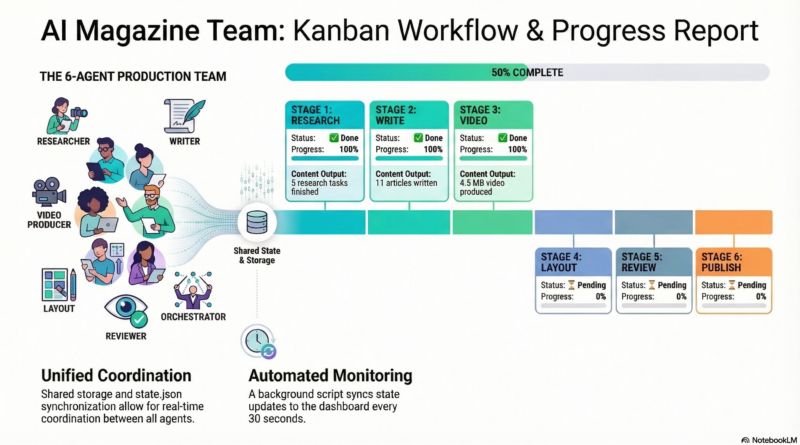
带看板仪表盘的自主杂志代理团队
—
title: “Autonomous Magazine Agent Team with Kanban Dashboard”
—
I built an autonomous magazine production team using AI agents, complete with a real-time kanban dashboard for tracking progress.
## The Challenge
Produce a daily magazine with multiple articles in different languages, a video news summary, and high-quality layout — all coordinated automatically.
## The Solution: 6 Specialized Agents
| # | Agent | Task | Output |
|---|---|---|---|
| 1 | Content Researcher | Scrapes and organizes content from multiple sources (world news, tech, science, culture, lifestyle). Finds special sections like history, poetry, jokes, recipes, and art. | /articles-raw/YYYY-MM-DD-research.json |
| 2 | Content Writer | Writes all articles from the research in Chinese, English, and Japanese. Creates 11+ pieces per day across different sections. | /articles-draft/YYYY-MM-DD-articles/ |
| 3 | Video Producer | Creates a 70-90 second news video using Remotion with AI voice narration, Chinese subtitles, and background music. | /videos-final/today-YYYY-MM-DD-news.mp4 |
| 4 | Magazine Layout | Assembles the final HTML magazine with bilingual headers, responsive design, and embedded video. | /magazine/YYYY-MM-DD.html |
| 5 | Quality Reviewer | Reviews everything before publication (accuracy, video playback, link validation, translation correctness). | /articles-review/ |
| 6 | Orchestrator | Final approval, publishes to web server, archives, and announces. | Live published magazine |
## The Workflow
“`Research → Write → Video → Layout → Review → Publish“`
Each agent works independently but reports back to a central `state.json` file that tracks:
– Status of each stage (pending, in-progress, done)
– Agent assignments
– Output paths
– Completion notes
– Overall progress metrics
## Kanban Dashboard
To make the invisible work visible, we built a real-time kanban board.
**Example Dashboard:** http://162.43.92.249:8000/daily-magazine/team-dashboard-copy/kanban.html
**What the Dashboard Shows:**
– 6 columns – One for each workflow stage
– Visual task cards – 5-7 tasks per stage with status information
– Live progress bar – Overall completion percentage
– Summary stats (tasks completed, in-progress, articles created)
– Auto-refreshes every 30 seconds
**Status Badges:**
– Done – Completed tasks have checkmarks
– In Progress – Some tasks marked complete
– Pending – No tasks completed yet
## Technical Highlights
**Shared Storage Layout:**
“`
/magazine-team/shared/
├── articles-raw/ # Research output (JSON)
├── articles-draft/ # Written articles (markdown)
├── videos-final/ # Completed video (MP4)
├── magazine/ # Final HTML magazine
└── state.json # Single source of truth
“`
**Agent Communication:**
Agents don’t talk directly. Each agent:
1. Reads the current state.json
2. Performs their assigned work
3. Writes output to designated directory
4. Updates state.json with status = “done” and notes
## Current Progress (March 23, 2026)
| Stage | Status | Tasks Done | Output |
|---|---|---|---|
| Research | Done | 5/5 | 8 world news, 6 tech, 2 science, 4 culture articles |
| Write | Done | 10/10 | 11 articles in 3 languages (ZH, EN, JA) |
| Video | Done | 6/6 | 70-second video with narration and subtitles |
| Layout | In Progress | 0/7 | Magazine HTML assembly |
| Review | Pending | 0/6 | Quality checks |
| Publish | Pending | 0/5 | Final deployment |
| Overall Progress: 50% (3 out of 6 stages complete) | |||
## Why This Works
| Principle | Description |
|---|---|
| Separation of Concerns | Each agent has one clear job and responsibility |
| Single Source of Truth | state.json eliminates confusion and provides coordination |
| Visual Transparency | Anyone can see progress at a glance via kanban dashboard |
| Automatic Coordination | Agents check state.json, not each other – no direct messaging |
| Human Oversight | Dashboard lets humans spot issues quickly and intervene if needed |
## Future Enhancements
| Enhancement | Description |
|---|---|
| Auto-assignment | Agents self-assign tasks from state.json based on their capabilities |
| Budget Tracking | Monitor token usage and costs per agent |
| Error Handling | Automatic retry on failure with escalation to human after N attempts |
| Multi-day Planning | Create next-day task list proactively to reduce wait time |
| History View | Archive of previous workflow states for analysis |
| Analytics | Time per stage, agent efficiency metrics, and bottleneck detection |
## Conclusion
Building an autonomous agent team doesn’t require complex orchestration. Sometimes the simplest approach is best: clear roles, shared state file, dashboard for visibility, and linear workflow for predictability.
The kanban board transforms invisible background work into a visible, trackable process. Team members and stakeholders can check in anytime without interrupting the agents.
**Example Dashboard:** http://162.43.92.249:8000/daily-magazine/team-dashboard-copy/kanban.html
Built with OpenClaw, running on local infrastructure, orchestrated by state.json.