
NotebookLM Memory Backup: AI-Powered Weekly Insights
NotebookLM Memory Backup: AI-Powered Weekly Insights
Memory is the foundation of productivity. Without a reliable system to capture, organize, and learn from your experiences, you’re constantly reinventing the wheel. Today, I want to share how I built an automated memory backup system using NotebookLM that transforms raw daily logs into actionable weekly insights.
The Memory Problem
Most of us struggle with memory management. We jot down notes in various places—text files, notebooks, apps—but rarely revisit them. The information sits there, dormant, while we repeat mistakes and forget valuable lessons. The real value of memory isn’t in storing it; it’s in making it accessible and actionable.
Traditional note-taking apps help you capture information, but they don’t help you synthesize it. You end up with a graveyard of notes that you never look at again. What you need is a system that not only stores your experiences but also helps you learn from them.
Enter NotebookLM
NotebookLM is Google’s AI-powered research assistant that transforms how you work with information. It can ingest documents, websites, and text, then answer questions, generate summaries, and uncover connections you might have missed. But what makes it powerful for memory management is its ability to analyze large volumes of text and extract meaningful patterns.
The key insight is that NotebookLM doesn’t just store your memory—it understands it. When you feed it your daily logs, it can identify recurring themes, track progress toward goals, and surface insights that would take hours to discover manually.
Building the Hybrid System
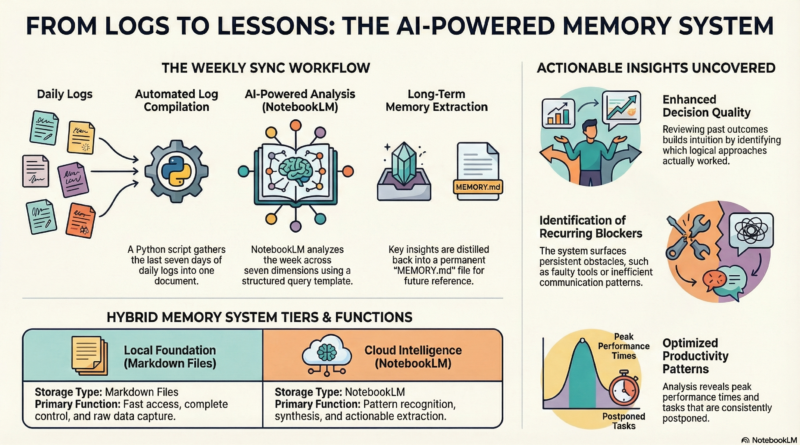
I’ve implemented a two-tier memory system that combines local storage with AI-powered analysis. Here’s how it works:
Local Storage (The Foundation):
– Daily logs in `memory/YYYY-MM-DD.md` format
– Curated long-term knowledge in `MEMORY.md`
– Raw, unfiltered notes captured in real-time
– Fast access, complete control, no dependencies
Cloud Analysis (The Intelligence):
– Weekly compilation of daily logs
– Upload to NotebookLM for AI analysis
– Structured query template for consistent insights
– Extracted learnings fed back into local memory
This hybrid approach gives you the best of both worlds: the speed and reliability of local storage, combined with the analytical power of AI.
The Weekly Sync Workflow
Every week, the system automatically compiles the last seven days of memory files and prepares them for NotebookLM analysis. Here’s the workflow:
1. Compilation:
The script gathers all daily memory files from the past week and combines them into a single document. This creates a comprehensive view of your activities, decisions, and learnings.
2. Upload:
You manually upload the compiled weekly memory to NotebookLM. This step requires human interaction because Google’s security prevents full automation of the login process.
3. Analysis:
A structured query template asks NotebookLM to analyze the week across seven dimensions:
– Tasks completed
– Decisions made with rationale
– Blockers and challenges
– Mood and energy levels
– Key learnings
– Action items
– Progress tracking
4. Extraction:
The AI-generated summary is processed and key insights are distilled into your long-term memory file (`MEMORY.md`), ensuring valuable lessons persist beyond the weekly cycle.
What the Analysis Reveals
The power of this system becomes clear when you see the output. Here’s what a typical weekly analysis uncovers:
Productivity Patterns:
You might discover that you’re most productive on Tuesday mornings, or that certain types of tasks consistently get postponed. These patterns help you optimize your schedule.
Decision Quality:
By reviewing decisions made throughout the week, you can identify which approaches worked and which didn’t. This builds your decision-making intuition over time.
Recurring Blockers:
The analysis surfaces obstacles that keep appearing—maybe it’s a particular tool that’s always breaking, or a communication pattern that causes delays. Identifying these patterns lets you address root causes.
Learning Velocity:
You can track how quickly you’re acquiring new skills and knowledge. Are you making the same mistakes repeatedly, or are you genuinely learning and improving?
Actionable Insights
The real value comes from turning insights into action. Each weekly analysis generates specific action items that you can implement immediately:
Immediate Actions:
– Configure missing API keys that are blocking automation
– Set up cron jobs for recurring tasks
– Integrate notification systems for better awareness
Strategic Adjustments:
– Shift time allocation based on productivity patterns
– Reallocate resources away from recurring blockers
– Double down on approaches that are working
Long-term Planning:
– Update goals based on progress tracking
– Adjust timelines based on learning velocity
– Plan capacity based on energy patterns
Technical Implementation
The system is built with a few simple scripts that handle the heavy lifting:
Weekly Compilation Script:
python3 scripts/notebooklm_upload_helper.pyThis script gathers the last seven days of memory files, compiles them into a single document, and prepares the structured query template for NotebookLM analysis.
State Tracking:
A JSON file tracks execution history, last sync times, and next scheduled summaries. This ensures the system maintains continuity across weeks.
Automated Scheduling:
Cron jobs handle the weekly compilation and daily memory recording, reducing manual intervention to just the NotebookLM upload step.
The Results
After implementing this system, the impact has been immediate:
Better Decision Making:
With a clear record of past decisions and their outcomes, I can make more informed choices. I’m not just guessing—I’m building on experience.
Faster Learning:
Instead of repeating mistakes, I’m identifying patterns and adjusting my approach. The learning curve has accelerated significantly.
Increased Awareness:
The weekly analysis surfaces insights I would have missed. It’s like having a thoughtful colleague review your work and point out what you might have overlooked.
Reduced Cognitive Load:
Knowing that my memory is being systematically captured and analyzed frees up mental space. I don’t have to worry about forgetting important details—the system has it covered.
Getting Started
You can implement a similar system with minimal setup:
1. Start Daily Logging:
Create a simple daily note template. Capture what you did, what you learned, and what you decided. Keep it brief—5-10 minutes is enough.
2. Set Up Local Storage:
Organize your notes with a clear structure. Daily files in one folder, curated insights in another. Consistency matters more than complexity.
3. Choose Your Analysis Tool:
NotebookLM is excellent, but you could also use other AI tools like Claude, ChatGPT, or specialized note-taking apps with AI features.
4. Establish a Weekly Routine:
Pick a consistent time each week to compile and analyze your memory. Sunday evening or Monday morning works well for most people.
5. Extract and Apply:
Don’t just generate insights—act on them. Update your long-term memory, adjust your processes, and implement the action items that emerge.
The Future of Memory
As AI tools continue to evolve, memory management will become increasingly automated and intelligent. We’re moving toward a future where your digital assistant not only captures your experiences but proactively surfaces relevant insights at the right moment.
The key is to start building good habits now. Establish the foundation of consistent logging and regular review. As the tools improve, your system will scale with them.
Conclusion
Memory is too important to leave to chance. By combining reliable local storage with AI-powered analysis, you can transform raw experiences into actionable wisdom. The NotebookLM memory backup system I’ve described is one approach, but the principles apply regardless of the specific tools you use.
Start small. Begin with daily logging. Add weekly analysis. Extract key learnings. Apply them consistently. Over time, you’ll build a memory system that doesn’t just store your past—it powers your future.
The best time to start was yesterday. The second best time is now. Your future self will thank you.